

Atkins combines experience with desire to serve
That's why he's running for a seat on the Louisiana Public Service Commission

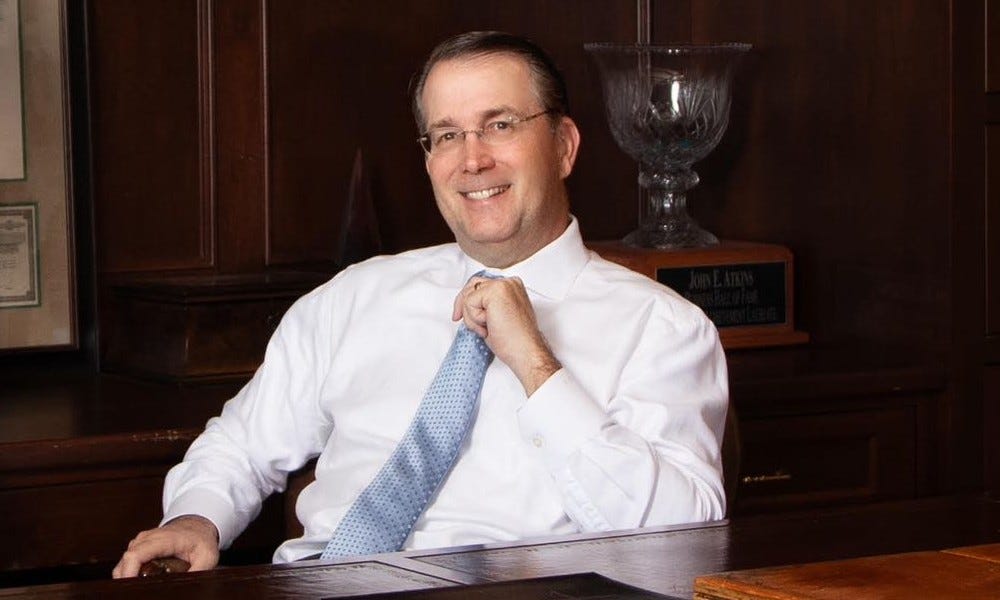
For John Atkins, the reasons to run for a seat on the Louisiana Public Service Commission are simple.
“One is a desire to be of service to our community, and second is a genuine interest in the content that we’re dealing with, particularly the electric power side,” Atkins said in a recent interview with Daniel Erspamer of the Pelican Institute for Public Policy.
He said the desire to serve has been with him since his school years when he took a career interest exam.
“I didn’t know what success looked like by taking that service path, but what that test was really telling me is I had a desire to serve,” Atkins says. “But at the time, I didn’t realize that that’s what it was telling me.
“I went through college and geology grad school and then pursued a commercial career in the energy sector. So I learned a good deal about utilities over those seven years, working for those firms and developed real interest in the space.”
A successful businessman, Atkins is a principal and partner of Atco Investment Company, an asset management company focusing on oil and gas, timberland and alternative assets. He also is a co-founder and partner in Louisiana Timber Partners and serves on the boards of directors of two privately-held companies: Aeropres Corporation, a Louisiana-based manufacturer of industrial gases, and Maven Royalty Partners LLC, an acquirer of oil & gas mineral interests.
When Atkins returned to his Louisiana roots, he ran to serve on the Caddo Parish Commission, which he has done for the last 11 years.
“And so now, I’m looking forward to trying to continue to serve as a public service commissioner in a space I feel like I know something about,” he said. “It’s where I feel like I can make a real contribution to the process.”
Atkins, a third-term Republican Caddo Parish Commissioner from Shreveport, is running for the state PSC District 5. His opponent in the May 16 Republican primary is Aiden Joyner. James Green and Austin Lawson are running in the Democratic primary. Incumbent Foster Campbell, a Democrat, can’t run because of term limits after 18 years on PSC.
District 5 covers northwest Louisiana, from the Texas border to the Mississippi line. Shreveport-Bossier, Ruston and Monroe-West Monroe are the district’s population hubs.
Early voting is scheduled May 2-9.
The five-member Louisiana PSC primarily regulates utility companies along with a few other industries such as towing and moving van companies. Its members have the power to set rates for electricity and approve or deny large infrastructure projects such as new power plants and intrastate pipelines.
Atkins said the biggest priority facing the Louisiana PSC is “to do no harm.”
“Like a good surgeon, you don’t want to harm a system that’s working fairly well right now,” he says. “I do believe we have room for improvement. If you look at one of our large investor-owned utilities in the state, if you look at their residential rates for the standard 1,000 kilowatt hour per month customer, that rate was about 10 cents a kilowatt hour in 2019. It’s now 14 cents a kilowatt hour. So that’s a 40% increase over six years. Or, a 6.5% increase per year.
“The CPI, the consumer price index, is about 3.7 or that same period. So, you know, that’s a challenge, that the utilities really need to address, or work to address.”
Atkins says the base rates for utilities have expanded dramatically in recent years.
“I think we need to look for ways like that to continue to reduce costs,” he says. “I think we need to look at ways that, if you look at that rate base we talked about, that’s grown considerably, and we need to do our best to reduce that going forward.
“We need to make sure that we don’t continue to add to it in an irresponsible way.”
Atkins also said it’s important for the PSC to work with utilities pursuing new projects to make sure costs are managed “in the best way possible.”
“A regular businessperson like myself wants to spend the least amount of equity possible to get a deal done,” he says. “Utilities are incentivized to put as much equity as possible so they’ll get a return on their equity.
“We want to make sure that when they are pursuing a project, that they complete that project at the lowest cost possible. To be fair, part of their cost structure is regulation.
“So, the more we can reduce the number of regulatory hurdles they have to cross over, perhaps that’ll compress their timeline, compress their front engineering design work and allow them to actually reduce those costs,” Atkins says.
Atkins also is open to “exploring some new avenues,” noting deregulatory actions that have taken place in Texas.
“Given the increases we’re seeing in the cost of power to the residential customers and the hopeful pipeline of growth we have in our state, we have to be open to looking at alternatives,” he says. “Now, I am not throwing stones at our existing utilities. I think they’re doing a fine job in many ways, but we do need to look after the well-being of our residential customers as well.
“Like, for example, are there infinite power producer options that can help large users, large consumers, without burdening the great base with additional capital that is then passed on to the residential customers.
“I think that the utilities been doing a great job with some of their contracting … working with the data centers to ensure that any generation they build will be covered, will be covered by the custom rights for which it’s being built and that the contracts are long enough where the vast majority of that facility, that power plant, that generation facility will have been depreciated at the tip by the time the contract ends.”
Atkins, who lives in Shreveport, recently announced he won’t accept campaign donations from the utilities he would regulate as a member of the PSC.
“I just decided … I really wanted to have more of an arm’s length discussion,” he says of that decision. “I’m always going to talk to the utilities. They’re a key player. You’ve got to talk to them. And I’m always going to talk to the residential customers.
But I respect the utilities. I think they make a great contribution to our society and our community. But you know, everybody needs to be held accountable.”