

Chattin wants to take experience to Knox Co. Commission
Current County Council member seeks GOP nomination for District 3

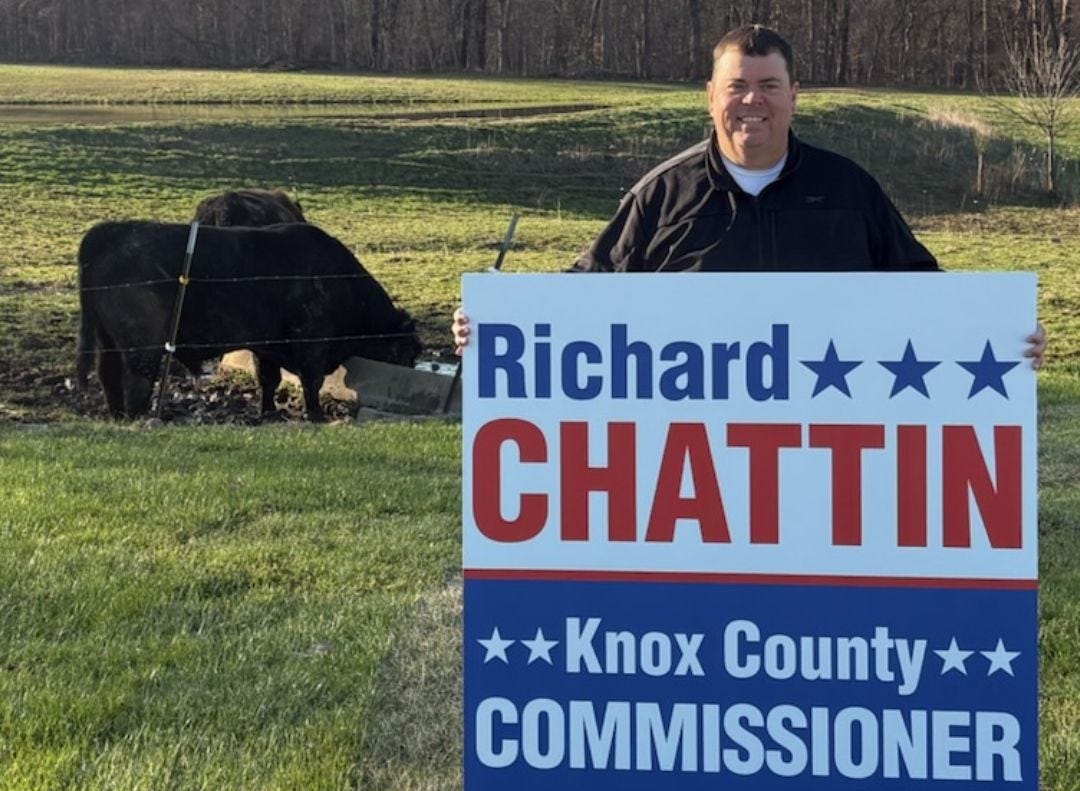
Richard Chattin has served on the Knox County Council for more than seven years. He now is ready to move into a new office.
Chattin is running for the District 3 seat on the Knox County Commission. He faces off against Matt Hoffman in the Republican primary, which is set for May 5. Early voting already has begun. No Democrats filed for the seat.
In Indiana, the county council is the fiscal body while county commissioners act as the executive and administrative body.
Chattin is a lifelong Knox County resident as well as an auctioneer, Realtor, farmer and turkey producer. In addition to his time on the county council, he also has served on the county Farm Bureau board for more than years as well as several state and national committees. He also is heavily involved with 4-H.
“I take pride and truly love Knox County,” Chattin says. “I bring a proven record of listening, engaging in thoughtful discussion, and working to achieve solutions that serve the best interests of our entire community.”
The executive director of the Private Property Rights Institute praises Chattin.
“We found Richard Chattin to be a strong conservative voice who understands that protecting private property rights is essential to preserving economic freedom and local prosperity,” Charlie Kolean says.
Chattin says this election isn’t about one single issue.
“It is about working collaboratively with all citizens of Knox County to find a balanced approach that allows both economic development, operations financial viability and quality of life to coexist,” Chattin says.
Alternative energy is one topic that has been discussed heavily in Knox County recently. Chattin says he personally isn’t a strong proponent of solar or wind power, but he is “a firm supporter of private property rights.”
“Your voices matter, and I believe were working toward a balanced approach that protects landowner rights, supports responsible economic development, ensures public safety and respects neighboring homeowners,” Chattin says.
“Several of us elected officials have invested years of time and effort to make informed, responsible decisions for Knox County. These decisions were not reached lightly. Professional council was hired along with several groups at the table to discuss and learn about these new projects. These decisions are personal because we all live here as well.”
He notes the formation of the Knox County Energy Land Advisory Committee to help evaluate energy and business opportunities and provide recommendations to best support the outcome for the entire community.
“The reality is Knox County cannot afford to turn away responsible growth,” Chattin says. “Solar development has the potential to significantly increase our tax base and help reduce the burden on all property owners.”
In his role on county council, Chattin says he has the responsibility to consider the financial health and long-term sustainability of Knox County.
“These solar projects will contribute significantly to our tax base,” he says. “The base rate for farmland is approximately $2,700 per acre, while solar property is assessed at $7,700 per acre this year, increasing to $20,000 per acre next year.
“This increased assessed value provides meaningful support in stabilizing – and potentially reducing – the overall property tax burden for our residents.”