

Will John Young's PSC campaign see more jewelry donations?
Oddity from 2015 campaign leaves unanswered questions

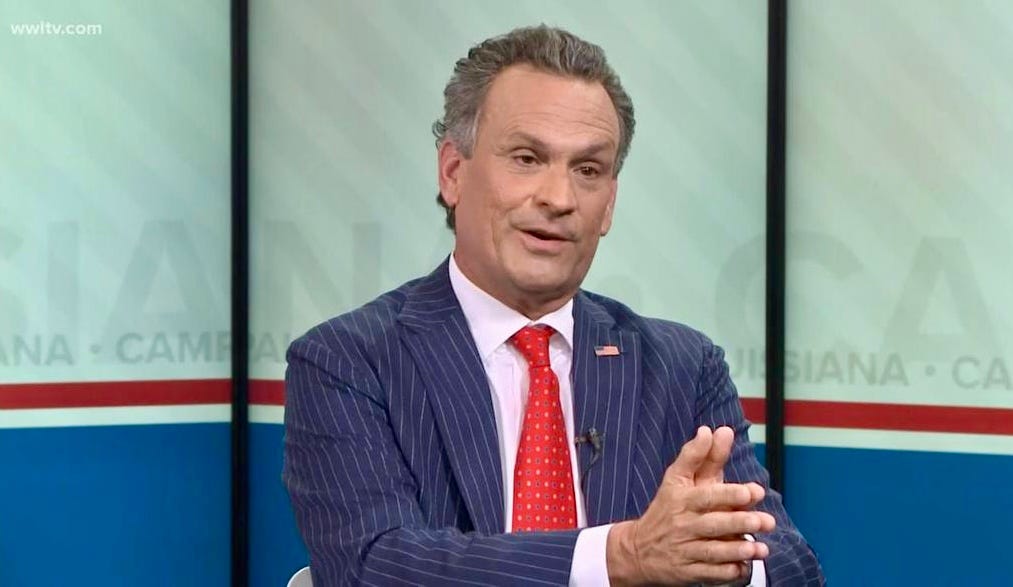
When John Young unsuccessfully ran for lieutenant governor in 2015, he had a campaign war chest of more than $1.8 million.
Most of that – about $1.5 million – was carried over from previous campaigns. And a look at those campaign finance reports shows one peculiar entry: $4,500 in merchandise from a Metairie jewelry store that had at least one building permit approved while Young was president of the Jefferson Parish.
Young, who now seeks election to the Louisiana Public Service Commission, was Parish President in 2014 when Boudreaux Fine Jewelers donated $4,500 worth of merchandise to Young’s campaign, according to Nola.com and Young’s campaign finance report. This was an in-kind contribution — merchandise rather than cash — reported for 2014 when Young was running for lieutenant governor.
Another reported in-kind contribution was a $4,100 helicopter ride from Panther Helicopters Inc. to Grand Isle for a council meeting and the International Tarpon Rodeo. He also charged Washington Mardi Gras expenses to his campaign account and covered a $730 membership fee to the Mystick Krewe of Louisianans, which organized the event.
The deadline for filing campaign finance reports for this year’s PSC race has not arrived yet. But these past campaign contributions could mean Young’s reports get closer scrutiny.
While public records don’t show Boudreaux’s Jewelers holding any contracts with Jefferson Parish, it did require a building permit in 2013, apparently for signage. It also required a building permit in 2021 for remodel repairs after Young was out of office.
While there is no evidence or appearance of impropriety regarding the Boudreaux’s Jewelers building permits, the mystery remains: What did Young’s campaign do with $4,500 in jewelry?
Like most Louisiana parishes, Jefferson Parish has rules requiring contractors and vendors seeking parish business to disclose campaign contributions precisely because of the pay-to-play concerns this kind of relationship can raise.
Jefferson Parish’s solicitation process for contracts required potential contractors to complete a campaign contribution affidavit, with failure to do so resulting in being deemed “non-responsive.”
According to the Federal Election Commission, a campaign would treat $4,500 in jewelry as a non-cash asset that must be reported at fair market value and then either used for campaign‑related purposes, sold to raise cash or potentially donated/returned under applicable rules.
If the jewelry was used as high‑value auction items, raffle prizes or silent‑auction pieces at a fundraising event, that would turn the in‑kind asset into multiple cash donations from attendees. In that case, the FEC each winning bidder’s payment is itself a contribution subject to limits and disclosure, separate from the original in‑kind donor’s contribution.
Young is running for the District 1 seat on the Louisiana PSC in the May 16 Republican primary. His opponents in the race are state Representative Stephanie Hilferty, Wallace “Wayne” Cooper, John Mason and Mark Wright. Connie Norris is running unopposed in the Democratic primary. Incumbent Eric Skrmetta (R-Metairie) is running for U.S. Senate.
Young spent nearly two terms on the Jefferson Parish Council from 2004 to 2010 before becoming Parish President until 2016. In 2015, he unsuccessfully ran for lieutenant governor. He served as an assistant Jefferson Parish attorney from 1997 to 2024.
He also was named as a defendant in a 2013 employment discrimination and sexual harassment lawsuit when he was Jefferson Parish president.
For Young’s 2015 lieutenant governor race, justia.com says a $4,500 jewelry gift would have legally functioned as an in‑kind contribution that had to be valued, documented and used only for campaign‑related purposes, not personal benefit.
Louisiana requires campaigns to record and report the “amount or value of the contribution of whatever value, and a description and valuation of all in‑kind contributions,” using estimated fair market value at the time received.
In‑kind donations (including jewelry) count toward the same per‑donor limits as cash, and the statute explicitly includes “any in‑kind contribution” when enforcing those caps. If $4,500 exceeded the donor’s allowable limit for that race and office level, the campaign would need to refund or otherwise cure the excess portion consistent with Louisiana campaign finance law.
According to online research, the most practical path for the campaign would have been to sell or auction the jewelry to raise cash. Then, the campaign could deposit the proceeds into the campaign account, then use the cash for ordinary campaign expenses (media, mail, staff, travel, etc.), still keeping the original gift recorded as a $4,500 in‑kind contribution.
If used in a fundraiser (auction/raffle item), each attendee’s payment to “buy” or win the jewelry becomes that attendee’s own contribution, which must be reported with name, address, amount, and date when it reaches reportable thresholds.
Campaign finance laws say the jewelry cannot be converted to personal use by Young, his family or staff. Personal use of campaign assets and contributions is restricted.
If the campaign decided it couldn’t appropriately sell or use the jewelry for campaign purposes, the conservative compliance options would be to return it to the donor or, if permitted by the broader rules for surplus/unused assets, donate it to a qualified nonprofit rather than allowing any personal benefit.